
6 Types of Product Photography Lebanese Brands Need (And Which Platform Each One Is For)
Last updated: 14 October 2026
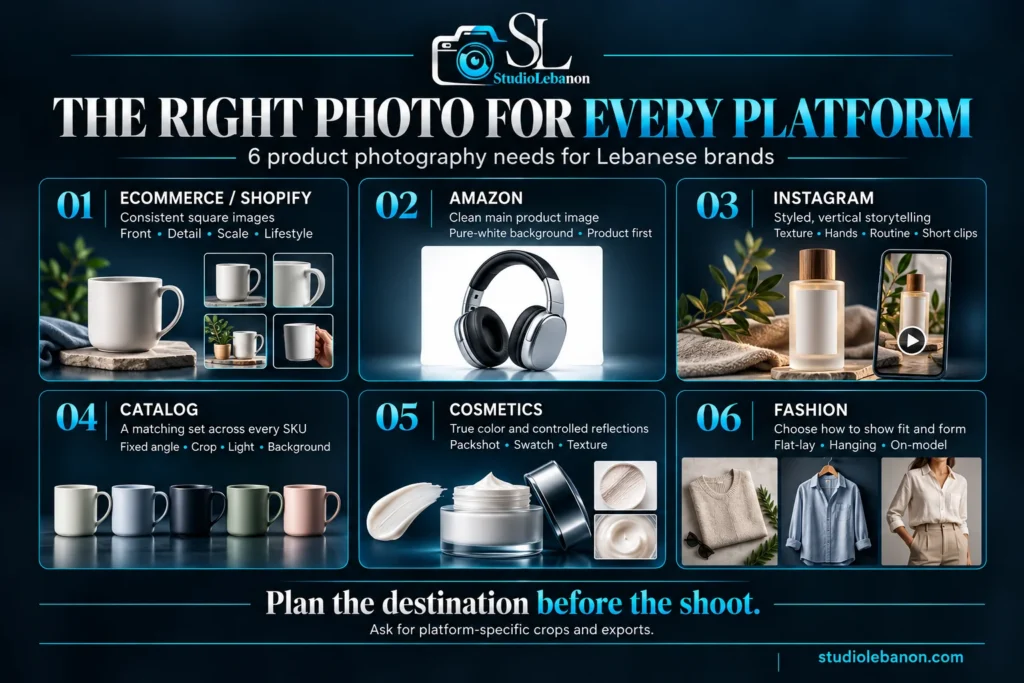
Ecommerce product photography in Lebanon is not one shoot. It is six different jobs: a pure-white 1:1 main image for Amazon, square 2048px shots for Shopify and your own site, 4:5 and 9:16 lifestyle content for Instagram, a consistent catalog set, reflection-controlled cosmetics shots, and flat-lay, hanging or on-model fashion images. Plan the shoot around where each photo will live, and one studio session can cover several platforms at once.
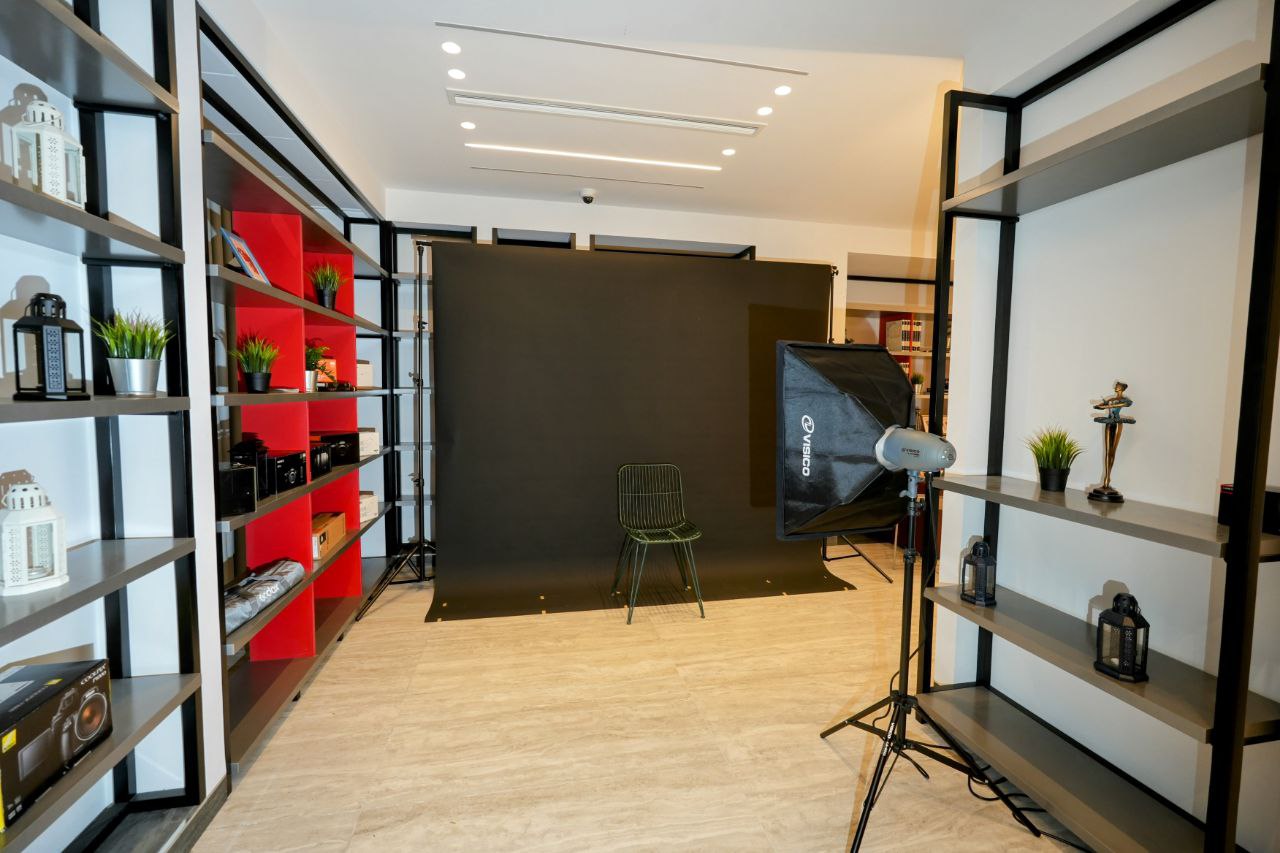
We run a product studio in Zouk Mosbeh, Keserwan, and shoot for brands from Beirut, Jounieh, the Metn and across Lebanon. The most expensive mistake we see is not a bad photographer. It is a brand that shoots one generic set of photos and then tries to force it onto every platform.
Below are the six use cases we plan around, what each platform actually requires, and how to turn that into a shot list.
What Lebanese Brands Are Actually Searching For
Before the findings, here is what we see in our own search data. Across the last 3 months, the use-case queries that lead people to our product photography page added up to roughly 480 impressions on Google:
| Search query (Google, last 3 months) | Impressions |
|---|---|
| ecommerce product photography lebanon | 97 |
| cosmetics product photography lebanon | 92 |
| catalog photography lebanon | 74 |
| amazon product photography lebanon | 71 |
| fashion product shoot lebanon | 64 |
| instagram product photography lebanon | 48 |
| shopify product photography lebanon | 31 |
| Total | 477 |
Two things stand out. First, people search by platform and category, not just “product photography.” Second, cosmetics is almost as big as general ecommerce, which matches what we shoot week to week. Most of these searchers are on their phones, too: 178 of roughly 234 Google clicks to our site came from mobile.
Finding 1: Ecommerce and Shopify Photos Need Square, High-Resolution, Consistent Images
Claim: For your own website or Shopify store, the photo has one job: let a customer inspect the product closely enough to buy without touching it.
Data: Shopify’s commonly cited recommendation for product images is 2048 × 2048 px, square (1:1). That size stays sharp when the theme zooms in, and square images keep your collection grid tidy. Shopify accepts larger files, but anything beyond this mostly adds page weight on a phone connection.
The shots that sell on a product page are predictable: a clean front view, a 45-degree angle, the back or label, a close-up of texture or detail, a scale shot (in hand or next to a known object), and one lifestyle image. We cover this in more depth in our e-commerce product photography guide.
Practical translation: Shoot every SKU at the same angles, on the same background, cropped square at 2048px, so your store looks like one brand rather than a mix of suppliers’ photos.
Finding 2: Amazon Has the Strictest Rules, and the Main Image Can Get Your Listing Suppressed
Claim: Amazon is the one platform where a “nice” photo can still be rejected. The main image follows hard rules; the secondary images are where you sell.
Data: Amazon’s main image requirements are well documented: a pure white background (RGB 255, 255, 255), the product filling about 85% of the frame, no added text, logos, badges or props, and at least 1000 px on the longest side so the zoom feature activates. Most sellers go to 1600px or more for sharper zoom. Off-white backgrounds, such as a light grey that looked white on set, are among the most common reasons a listing gets flagged.
The other slots (up to eight additional images on most listings) are free for infographics, dimensions, lifestyle shots and packaging. Lebanese brands selling abroad through Amazon often skip these, and that is where conversions are lost.
For large product ranges, follow our catalog photography workflow.
Practical translation: Shoot the Amazon main image on a lit white sweep, then check the background reads 255, 255, 255 in editing. Plan the remaining slots as a sales sequence, not as leftovers.
Finding 3: Instagram Rewards Vertical, Styled Content, Not White-Background Cutouts
Claim: Instagram is a scroll-stopping medium, so the photo has to earn attention before it can sell anything.
Data: Current Instagram specs: feed posts perform best at 4:5 portrait (1080 × 1350 px), which takes up more screen space than a square; 1:1 (1080 × 1080 px) still works; Reels and Stories are 9:16 (1080 × 1920 px). Since the profile grid switched to taller 3:4 previews, we keep key details centered so nothing important gets cropped on your profile page.
What works for Lebanese brands on Instagram: styled scenes with props that fit the brand, hands using the product, textures and close-ups, and short vertical clips of pouring, spraying, unboxing or applying. A white-background image looks like an ad in the feed, and people scroll past ads.
Practical translation: Shoot vertical from the start. Ask your studio to capture 4:5 stills and a few 9:16 clips during the same session, rather than cropping a square product shot later.
Finding 4: Catalog Photography Is About Consistency Across Every SKU
Claim: A catalog or wholesale line sheet lives or dies on consistency. One product shot at a different angle or color temperature makes the whole range look amateur.
Data: On catalog days we lock the camera position, lens, lighting setup, white balance and crop, then move products through the set. The goal is that product 1 and product 60 look like they were shot seconds apart. This matters for print catalogs, distributor PDFs and B2B portals, where buyers compare items side by side.
Catalog work is where batching pays off. Once the set is locked, each additional SKU takes minutes, not a new setup. That is why we quote full-day catalog shoots by scope rather than by the hour.
Practical translation: Send a complete SKU list before the shoot, group products by size and finish, and agree on one reference image that every other shot must match.
Finding 5: Cosmetics Photography Is Mostly a Lighting Problem
Claim: Beauty products are among the hardest items to photograph well, because the packaging fights the light and the customer judges color with their eyes.
Data: Three issues come up on nearly every cosmetics shoot we run:
- Reflective packaging. Glossy jars, glass bottles and metallic caps reflect everything in the room, including the camera. We control this with large diffused softboxes, flags and careful angles, then clean remaining reflections in retouching.
- Color accuracy. A lipstick or foundation that looks warmer online than in real life leads to returns and bad reviews. We shoot with a color reference and correct to it, so the shade on screen matches the product.
- Swatches and textures. Customers want to see the product out of the pack: a cream smear, a powder crush, a lipstick swatch on skin. These close-ups often outperform the packshot on Instagram.
Cosmetics is also a strong fit for our portfolio categories, which include beauty and cosmetics alongside beverages and branded bottles. You can see examples in our portfolio.
Practical translation: For every cosmetics SKU, plan a clean packshot, a texture or swatch close-up, and one styled scene, and ask the studio how they will handle reflections before you book.
Beauty brands can also see our cosmetics and Instagram photography ideas.
Finding 6: Fashion Needs a Choice Between Flat-Lay, Hanging and On-Model
Claim: Clothing has three standard shooting styles, and each one suits a different budget and platform.
Data: Here is how we explain the trade-off to fashion clients:
- Flat-lay: the garment laid out and styled from above. Fastest and cheapest per item, good for Instagram grids and basics like t-shirts and kids’ clothing.
- Hanging-garment: shot on a hanger or invisible mannequin setup. Shows drape and shape better than flat-lay, and works well for ecommerce product pages.
- On-model: the highest-converting option for most fashion, because customers see fit and movement. It adds model cost: you can bring your own, or we source models from $50/hour per model, quoted before the shoot. Our guide on how to book models for a product shoot in Lebanon covers the process.
Practical translation: Use flat-lay or hanging shots for the full range, and save on-model time for bestsellers and new-season hero pieces.
Comparison Table: Which Product Photo for Which Platform
| Use case | Background | Aspect ratio / size | Typical shots |
|---|---|---|---|
| Ecommerce / Shopify | White or light neutral, consistent | 1:1, 2048 × 2048 px | Front, 45°, back/label, detail, scale, 1 lifestyle |
| Amazon | Pure white RGB 255, 255, 255 (main image) | Min. 1000 px longest side (1600+ recommended), product ~85% of frame | Main packshot, infographics, dimensions, lifestyle |
| Styled scenes, color, props | 4:5 (1080 × 1350), 1:1 (1080 × 1080), Reels 9:16 (1080 × 1920) | Lifestyle, hands-in-shot, textures, short clips | |
| Catalog | Identical across all SKUs | Fixed crop agreed upfront (print and web) | Same angle for every product, group shots |
| Cosmetics | White, gradient or styled | Depends on platform above | Packshot, swatch/texture, styled scene |
| Fashion | White, neutral or location | 1:1 or 4:5 for web and social | Flat-lay, hanging, on-model, detail |
Myth: “A White Background Is All You Need Everywhere”
A white background is essential for Amazon and very useful for your own store. On Instagram, it is often the weakest option. White cutouts look like catalog pages in a feed full of people, color and movement.
The opposite myth is just as common: “phone photos are fine for Instagram.” Phones handle a quick Story well. They struggle with reflective packaging, accurate color and the sharpness that holds up when a customer zooms in on a product page. The same photos usually end up on your website too, which is where they cost you sales.
What actually matters is matching the image to the platform. One well-planned session with a white set and a styled set side by side gives you both.
What This Costs at StudioLebanon
Many studios in Lebanon do not publish their rates and quote per image or per package, which makes planning hard. We keep it simple and hourly: $80 for the first hour and $70 for each additional hour ($150 for 2 hours, $220 for 3, $290 for 4). Retouching, color correction, background removal and files sized for Shopify, Amazon and Etsy are included, with delivery in 3–5 business days.
A multi-platform shoot usually means a white set and a styled set in the same booking, which is where the extra hour pays for itself. Full pricing details and what is included are on our product photography page, and we break down real 2026 costs in our guide to product photography pricing in Lebanon. If you have your own photographer and gear, you can rent the studio from $50 per hour with lighting included, and our sister store at studiolebanon.com/shop stocks cameras, lenses and Godox and Amaran lighting if you are building an in-house setup. Our shop is priced to be the best in Lebanon: original gear and 2–3 business day delivery across Lebanon.
What to Do This Week
- List every platform where your product photos will appear: website, Shopify, Amazon, Instagram, catalog.
- Write down the required size and background for each one, using the comparison table above.
- Pick your 5–10 bestselling SKUs to shoot first rather than the full range.
- Build a shot list per SKU: white packshot, detail, scale, and one styled or vertical shot.
- Gather samples in perfect condition, with clean labels and no scratches or dents.
- Send your shot list to a studio and ask for a quote based on hours, not guesses.
FAQ
Can one photoshoot cover Amazon, Shopify and Instagram? Yes, if it is planned that way. We set up a white sweep for Amazon and web images and a styled set for Instagram in the same session, then export each image in the size each platform needs. Tell the studio every platform upfront so nothing has to be reshot.
What size should Amazon product photos be? At least 1000 px on the longest side so zoom works, and most sellers use 1600 px or more. The main image must be on a pure white background (RGB 255, 255, 255) with the product filling about 85% of the frame, and no text or logos added.
What is the best image size for Instagram product posts? Use 4:5 portrait at 1080 × 1350 px for feed posts, since it takes up more of the screen than a square. Use 9:16 at 1080 × 1920 px for Reels and Stories, and keep the key product details centered for the profile grid.
How do you photograph shiny cosmetics packaging? With large diffused light sources, flags to block unwanted reflections, and careful camera angles, followed by retouching to clean what remains. Color is checked against a reference so shades match the real product.
Is on-model fashion photography worth the extra cost in Lebanon? For bestsellers and hero pieces, usually yes, because customers can see fit and movement. For the full range, flat-lay or hanging shots are more cost-effective. At StudioLebanon, sourced models start from $50/hour per model, or you can bring your own.
Do you shoot for brands outside Zouk Mosbeh? Yes. Our studio is in Zouk Mosbeh, a short drive north of Beirut, and we work with brands across Lebanon. Most clients bring products to the studio, and on-location shoots are quoted by scope.
Plan Your Multi-Platform Product Shoot
Send us your product list and the platforms you sell on, and we will build a shot list and an hourly quote around it. We work in English, French and Arabic. Call or WhatsApp +961 76 393 638, email info@studiolebanon.com, or contact us here. Building your own product setup instead? studiolebanon.com/shop offers the best prices in Lebanon on original cameras, lenses and lighting.