
Catalog Photography in Beirut: How to Shoot 100+ Products Without Losing Consistency
Last updated: 14 October 2026
Catalog photography in Lebanon works when you treat it like a production line: lock one camera position, one lighting setup, one white balance and one crop, then move every product through that set. With products prepped and sorted, a locked set can realistically handle 100 or more simple SKUs at one angle in a long studio day (our estimate), and every image comes out matching. At StudioLebanon that is billed at $80 for the first hour and $70 for each additional hour, or quoted as a full-day catalog shoot by scope.
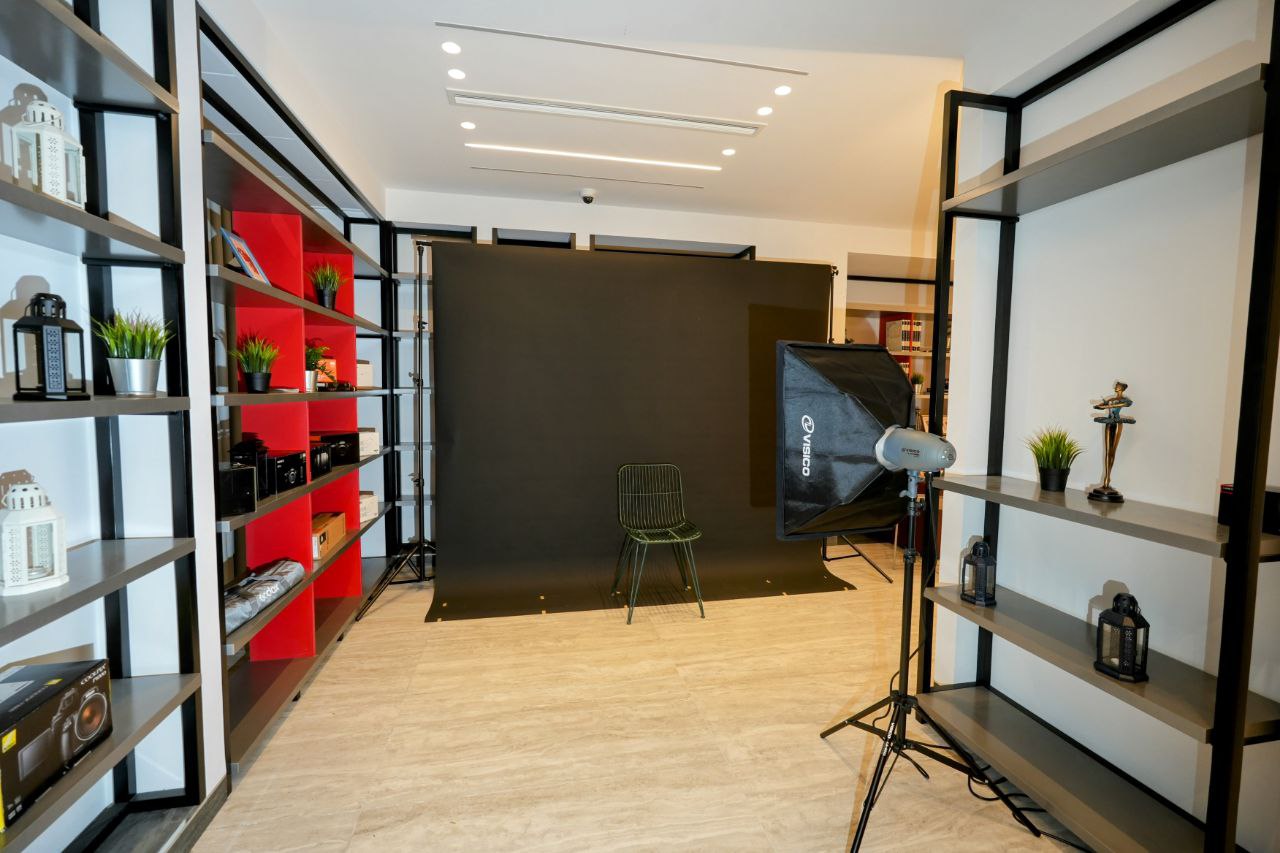
We shoot catalogs for distributors, wholesalers, manufacturers, retailers and restaurants from our studio in Zouk Mosbeh, Keserwan, about 15 to 20 km north of central Beirut. Clients come from Beirut, the Metn, Jounieh and further afield in Lebanon. The brief is almost always the same: “we have a lot of products, and they all need to look like they belong in the same book.”
Our guide to product photography by platform covers catalogs briefly next to Amazon, Instagram and fashion. This one is the deep version: how a catalog day runs, what it costs, how many SKUs to expect, and how the files should arrive.
What We See in Our Own Search Data
In the last 3 months, “product photoshoot beirut studio” earned 95 impressions for our site and “catalog photography lebanon” earned 74, where we already sit around position 7. That is 169 searches from buyers who are not asking for a pretty picture; they are asking who can photograph a whole range, properly, near Beirut. Most of them search on a phone: 178 of roughly 234 Google clicks to our site came from mobile.
Finding 1: Consistency Is the Whole Product
Claim: In a catalog, one mismatched image does more damage than ten average ones, because buyers compare products side by side.
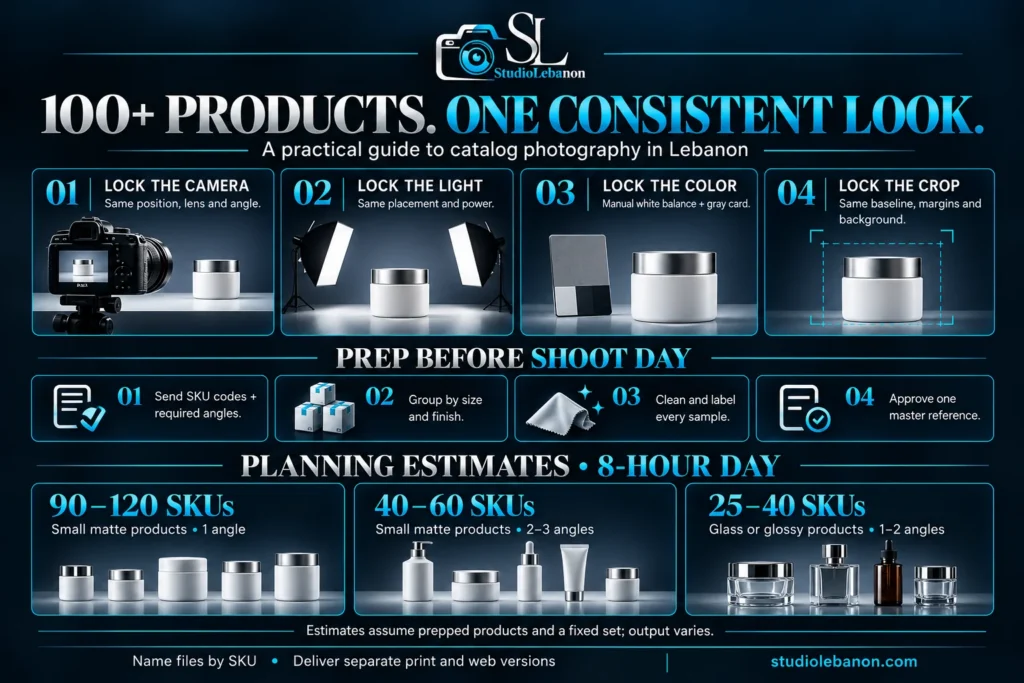
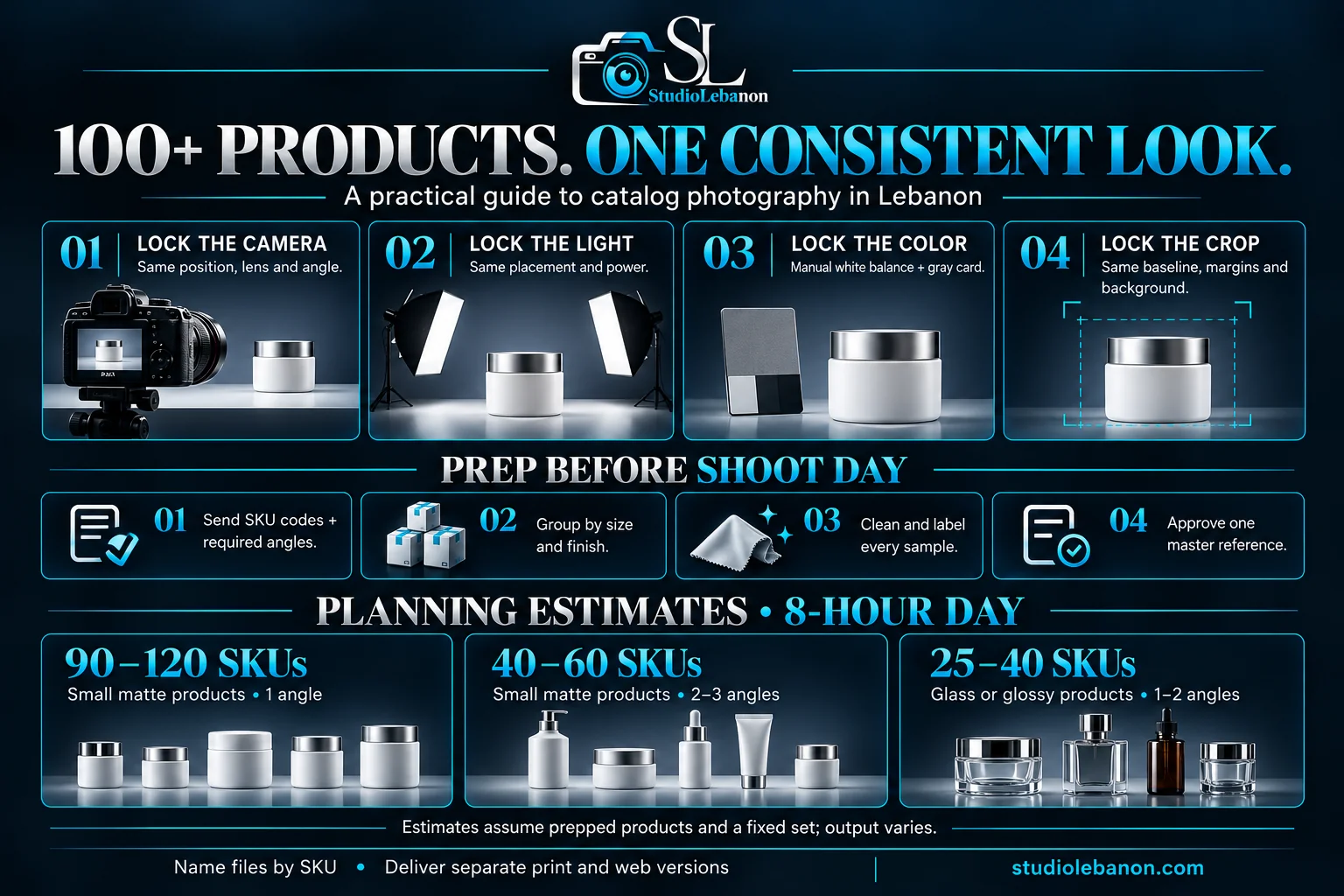
Data: A wholesale buyer flipping through a PDF line sheet notices instantly when one bottle is warmer, one box is shot slightly from above, or one item floats higher in the frame. It makes the range look like it came from different suppliers. These are the rules we lock before the first SKU:
- Camera position and lens: fixed on a tripod, marked on the floor, same focal length all day.
- Lighting: same lights, same power, same positions; nothing moves between SKUs.
- White balance: set manually from a gray card at the start and rechecked after breaks.
- Crop and placement: an overlay on the monitor so every product sits on the same baseline with the same margins.
- Background: white or one agreed color, identical for every product.
- Reference image: the first approved shot becomes the master every later shot is checked against.
Gear consistency matters too. If you are building an in-house catalog setup, a solid tripod and continuous LED lighting do most of the work; our gear store, studiolebanon.com/shop, stocks tripods, Amaran and Godox lights and cameras. It is priced to be the best in Lebanon: original gear and 2–3 business day delivery across Lebanon.
Practical translation: Agree on one reference image with your studio before the shoot, and judge every delivered photo against it.
Finding 2: SKU Throughput Depends on the Product, Not the Photographer
Claim: The honest answer to “how many products per day?” is: it depends on surface, size and angles, and anyone who quotes a flat number without seeing your list is guessing.
Data: These are our planning estimates for a locked studio set, assuming products arrive clean, unpacked and sorted. They are estimates from typical sessions, not guarantees:
| Product type | Angles per SKU | Estimated SKUs per hour | Estimated SKUs per 8-hour day |
|---|---|---|---|
| Small matte packaged goods (boxes, tubes, pouches) | 1 | 12–15 | 90–120 |
| Small matte packaged goods | 2–3 | 5–8 | 40–60 |
| Glass, chrome or glossy items (bottles, jewelry, cookware) | 1–2 | 3–5 | 25–40 |
| Apparel flat-lay or hanging | 1–2 | 5–8 | 40–60 |
| Restaurant menu dishes (cooked fresh, styled) | 1–2 | 3–5 dishes | 20–35 dishes |
Setup takes time too: the first 30 to 60 minutes of a catalog day typically go into building and testing the set. After that, the time per SKU drops sharply, which is why catalogs reward one long session over several short ones.
Practical translation: Count your SKUs by product type and angle, then use the table to estimate hours before asking for quotes.
Finding 3: The Catalog Day Is Won or Lost Before the Camera Comes Out
Claim: Most delays on catalog days are logistics: missing items, dusty packaging, unclear SKU codes.
Data: This is the order that keeps a catalog day moving:
- SKU sheet in advance: a spreadsheet with SKU code, product name, variant and required angles for every item.
- Group by size and finish: all small matte items together, then tall bottles, then reflective items, so lights change as rarely as possible.
- Clean samples: dust-free, labels straight, no dents; retouching can fix a scratch, but it costs time on every file.
- One decision-maker on set (or on WhatsApp) to approve the reference image and answer questions quickly.
- Live review on a big screen: ask for images to appear on a monitor as they are shot, so problems are caught on SKU 3, not SKU 83.
Practical translation: Send your SKU spreadsheet at least a few days before the shoot and have products sorted into labeled boxes by group.
Finding 4: File Naming and Delivery Save More Time Than Faster Shooting
Claim: A 300-image catalog that arrives as IMG_4821.jpg is a week of work for whoever builds your website or PDF.
Data: We name files by the SKU code you give us, in a fixed pattern such as SKU_view_variant.jpg (for example, 10425_front_red.jpg and 10425_side_red.jpg). We avoid spaces and special characters because some web platforms and ERP systems handle them badly. Files are delivered in separate folders by use:
- Print: full resolution, suitable for 300 dpi output.
- Web: resized, compressed JPEGs in sRGB, for example 2048 × 2048 px squares for Shopify-style stores.
- Marketplace or B2B portal: whatever size and background the platform requires, cropped to match.
Editing is included in our product photography rate: retouching, color correction, background removal and web and print optimization, with delivery in 3 to 5 business days and an expedited option.
Practical translation: Give your studio the exact SKU codes and naming pattern you want before the shoot, not after delivery.
Finding 5: Print and Web Need Different Files From the Same Shoot
Claim: A catalog photo that looks great on a website can print soft, and a print file can make a web page crawl.
Data: The standard rule for print is 300 dpi at the final printed size. A full-page A4 image needs about 2480 × 3508 px; a quarter-page product shot needs far less. Most current full-frame and APS-C cameras produce around 24 megapixels (6000 × 4000 px), which covers a full A4 page at 300 dpi with room to crop.
For web, the opposite applies: smaller files load faster on phones. Around 2000 px on the longest side is plenty for most catalog pages and zoom features. We deliver in RGB; if your printer needs CMYK, they (or your designer) should convert with their own press profile, because the right CMYK conversion depends on the paper and the press.
Practical translation: Tell the studio whether the catalog is print, web or both, and the largest size any image will be printed.
Finding 6: Hourly vs Full-Day: Model the Cost Before You Book
Claim: The cheapest pricing model depends on how many SKUs you have and how many angles each needs.
Data: Catalog quotes in Lebanon usually come per image, per day or by the hour, and many photographers do not publish their rates, so the only fair comparison is total cost for your whole SKU list with editing included. Our pricing is hourly at $80 for the first hour and $70 for each additional hour ($150 for 2 hours, $220 for 3, $290 for 4), with editing included. Full-day catalog shoots are quoted by scope.
Here is a worked estimate for a distributor with 60 matte products needing 2 angles each (120 images):
| Approach | Estimated time | Estimated cost | Cost per image |
|---|---|---|---|
| Per-image quote from any supplier | Not applicable | Every image billed separately | Ask whether each angle counts as a new image |
| StudioLebanon hourly, locked set (estimate) | About 8 hours | $570 | About $4.75 |
| StudioLebanon full-day catalog quote | One day | Quoted by scope | Depends on scope |
| Studio rental only, your own photographer | 8 hours | $200 + your photographer | Depends on your team |
The 8-hour figure assumes about 8 SKUs per hour at 2 angles (the top of our matte range, realistic for simple boxes on a locked set) plus about 30 minutes of setup. That is $80 for the first hour plus 7 × $70, or $570, which is about $4.75 per edited image across 120 images. At that length, ask us for a full-day catalog quote and compare it with the hourly total; we will tell you honestly which is cheaper for your list. Our full breakdown of how product photography is priced is in product photography pricing in Lebanon. If you already have a photographer, you can rent the studio for $200 for a full day with lights, softboxes, C-stands and backdrop support included.
Practical translation: Multiply your SKUs by angles, divide by a realistic hourly rate from the throughput table, and compare the result against per-image and full-day quotes.
Finding 7: A Studio Just North of Beirut Beats a Makeshift Set in a Warehouse
Claim: For most catalogs, bringing products to a controlled studio is faster and more consistent than building a set in a storeroom.
Data: Warehouses and shops have mixed light from windows and fluorescent tubes, little space to back the camera up, and constant interruptions. A studio gives controlled light that never changes with the time of day, which is exactly what consistency needs. From Beirut, Zouk Mosbeh is a short drive up the coast, and many clients simply load a car with sorted boxes in the morning.
Some jobs do belong on location: restaurant menus where dishes must go straight from the kitchen to the camera, heavy machinery or furniture, or stock that cannot leave a bonded warehouse. We quote on-location shoots by scope and bring a portable version of the same locked-set approach. You can see the full range of what we do on our services page.
Practical translation: If your products fit in a car, bring them to a studio; if they cannot move (or must be cooked fresh), ask for an on-location quote.
Myth: “Background Removal Will Fix Inconsistency Later”
Cutting products out onto white is useful, and it is included in our editing. But it does not fix different angles, different lighting directions or different color temperatures. A bottle lit from the left will still look wrong next to one lit from the right, even on identical white.
What actually matters is locking the set once and not touching it. The time you save in editing is time you do not pay for, and the catalog looks professional because it was shot consistently, not because it was repaired.
What to Do This Week
- Export your full product list with SKU codes, variants and the angles each item needs.
- Group products by size and finish (matte, glass, metal, apparel, food).
- Estimate your hours with the throughput table, and decide on print, web or both.
- Pick or approve one reference image that every product must match.
- Clean and box your samples by group, labeled with SKU codes.
- Send the list to a studio and ask for both an hourly estimate and a full-day catalog quote.
FAQ
How much does catalog photography cost in Lebanon? It depends on your SKU count, the angles per product and how reflective the items are. At StudioLebanon we charge $80 for the first hour and $70 for each additional hour, with editing included, and quote full-day catalog shoots by scope once we see your SKU list.
How many products can you photograph in a day? As an estimate, a locked set can handle roughly 90 to 120 small matte products at one angle in an 8-hour day, or 40 to 60 at 2 to 3 angles. Glass, chrome and glossy products are slower, around 25 to 40 a day. The real number depends on your products and how well they are prepped.
What resolution do I need for a printed catalog? 300 dpi at the final printed size. A full A4 page needs about 2480 × 3508 px, which a standard 24-megapixel camera covers comfortably. Ask for separate web files so your website stays fast.
Can you photograph our products at our warehouse or restaurant? Yes. On-location shoots are quoted by scope. For restaurant menus it is often the better option, because dishes go straight from the kitchen to the set. For packaged goods, bringing products to our studio is usually faster and more consistent.
How are the files delivered? Named by your SKU codes in a fixed pattern, split into print, web and marketplace folders, and delivered within 3 to 5 business days, with an expedited option. Retouching, color correction and background removal are included.
Where is your studio? In Zouk Mosbeh, Keserwan, about 15 to 20 km north of central Beirut. We work with distributors, retailers and brands across Lebanon, in English, French and Arabic.
Get a Catalog Quote
Send us your SKU list with the angles you need and whether the catalog is for print, web or both. We will come back with an hourly estimate and a full-day option so you can compare. Call or WhatsApp +961 76 393 638, email info@studiolebanon.com, or contact us here. Setting up an in-house catalog corner? studiolebanon.com/shop offers the best prices in Lebanon on original tripods, lights and cameras.