Cosmetics & Instagram Product Photography in Lebanon: 7 Shots That Actually Sell (and What They Cost)
Last updated: 14 October 2026
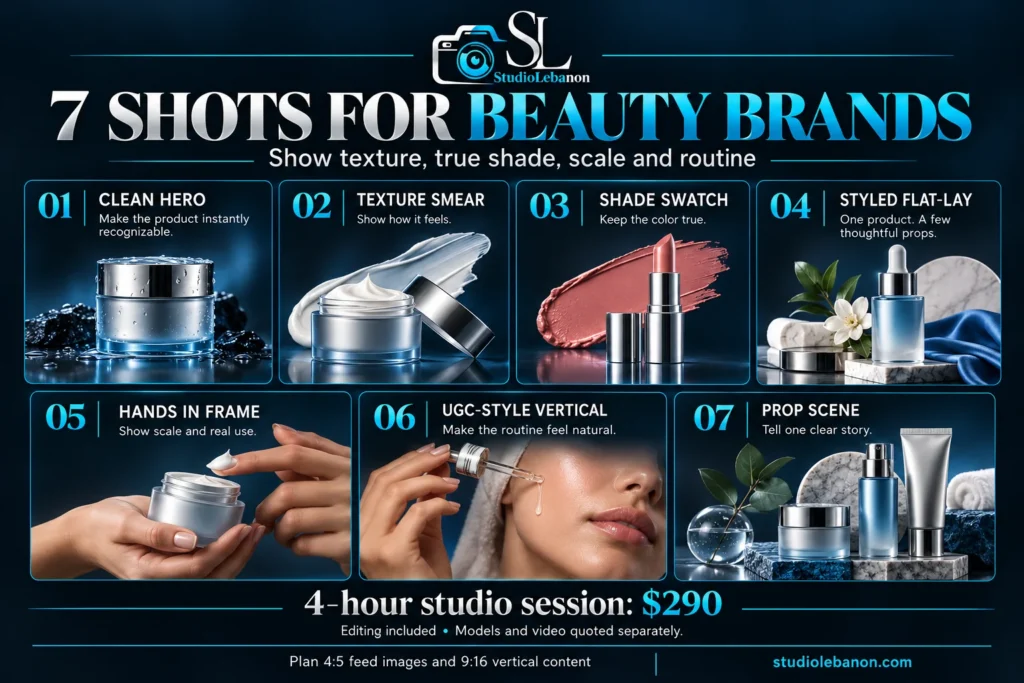
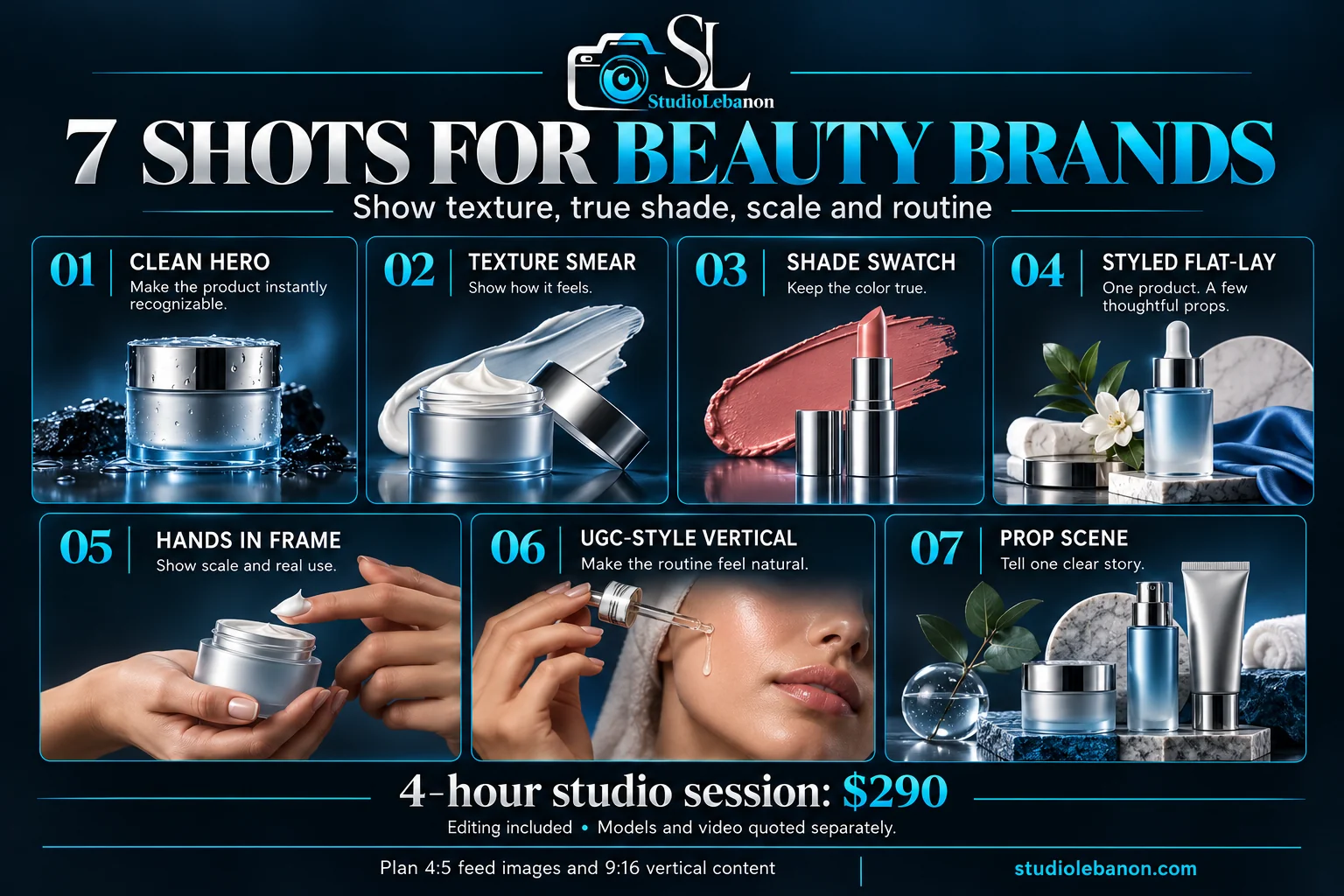
Cosmetics product photography in Lebanon sells on Instagram when it shows what a customer cannot feel through the screen: texture, true shade, scale in a hand and the product in a real routine. The 7 shots that consistently earn their place are the clean hero, the texture smear, the shade swatch, the styled flat-lay, the hands-in-frame shot, the UGC-style vertical and the prop scene. At StudioLebanon a 4-hour studio session costs $290 with editing included, and a well-planned one produces a month or more of feed content.
We shoot beauty, skincare, perfume and lifestyle products every week in our studio in Zouk Mosbeh, Keserwan, for brands based in Beirut, Jounieh, the Metn and across Lebanon. Most of them sell through Instagram first and a website second. This guide is the practical version: which shots to plan, how to light glass and metal, how to keep shades honest, and how to turn one shoot into a month of posts.
If you need the platform-by-platform overview (Amazon, Shopify, catalog, fashion), start with our guide to product photography by platform. This article goes deeper on one corner of it: beauty and lifestyle brands selling on Instagram.
What We See in Our Own Search Data
Over the last 3 months, “cosmetics product photography lebanon” earned 92 impressions on Google for our site at an average position of about 8, and “instagram product photography lebanon” earned 48 impressions at about position 10. That is 140 searches in one quarter from people asking a very specific question, and the answers on page one are mostly generic “DM us” pages.
The other signal: 178 of roughly 234 Google clicks to our site came from mobile. Beauty founders are researching photographers on the same phone they post from. That is also the screen your photos will be judged on, so everything below is planned for a 6-inch vertical display first.
Finding 1: The Texture Shot Outsells the Packshot on Instagram
Claim: For skincare and makeup, the product out of the pack is more persuasive in the feed than the pack itself.
Data: A clean packshot answers “what does it look like?” A texture shot answers the question that actually stops a scroll: “what will it feel like on my skin?” A serum drop on glass, a cream swirl with a visible peak, a crushed highlighter, a balm with a finger dip in it. These close-ups are the shots our beauty clients reuse most, across posts, Stories and ads.
Texture shots need a macro or close-focusing lens, hard-ish light raking across the surface to show relief, and a fresh sample every few frames because creams skin over and gels pool under studio lights. We budget roughly 10 to 15 minutes per texture setup (an estimate that assumes the product is ready and the surface is clean).
Practical translation: For every hero SKU, plan at least one texture shot alongside the packshot, and bring a spare unit you are happy to open.
Finding 2: Shade Swatches Only Work If the Color Is Accurate
Claim: For foundation, lipstick, blush and tinted products, an inaccurate swatch is worse than no swatch, because it creates returns and angry comments.
Data: Color shifts come from three places: the light (mixed daylight and warm bulbs), the camera’s auto white balance, and the phone screen the customer uses. We control the first two by shooting under consistent studio light with a gray card or color reference in the first frame of every setup, then correcting to that reference in editing. Color correction is included in our product photography rate.
Two habits make swatches trustworthy: shoot the swatch next to the physical product so viewers can compare, and shoot swatches on more than one skin tone for foundation and concealer ranges. You can bring your own models or add StudioLebanon models from $50/hour per model, quoted before the shoot. Our guide on how to book models for a product shoot in Lebanon walks through it.
We deliver in sRGB, the color space Instagram and web browsers expect. A file exported in a wide color space can look dull or oversaturated once uploaded.
Practical translation: Put a gray card in the first frame of every swatch setup, and ask to see an unedited frame next to the real product before approving shades.
Finding 3: Glass Bottles and Metallic Caps Are a Lighting Problem, Not an Editing Problem
Claim: Perfume bottles, glass droppers, chrome caps and gold compacts reflect the whole room, and trying to fix that in retouching is slow and usually looks fake.
Data: On reflective products we solve it on set:
- Large diffused sources. A big softbox close to the product creates one smooth, long highlight on glass instead of a dozen hot spots.
- Black and white cards. Black cards on the sides define the edges of clear glass; white cards fill metallic caps so they read as metal, not as a black hole.
- Backlighting for liquids. Light behind a perfume or serum bottle makes the liquid glow and shows its real color.
- Angle and distance. A longer lens from further back keeps the camera and photographer out of chrome reflections.
- Clean samples. Fingerprints and dust show on glass at full size. We wear gloves and wipe between frames.
Reflective products take longer. Where a matte tube might need a few minutes per angle, a clear perfume bottle with a metal cap can take 2 to 3 times longer to light cleanly (our estimate from typical sessions). Plan your booking with that in mind.
Practical translation: Tell the studio which SKUs are glass, chrome or gold before the shoot, so the time goes into lighting rather than retouching.
Finding 4: Hands-in-Frame and UGC-Style Content Build Trust Faster Than Perfect Studio Shots
Claim: On Instagram, a real hand pumping a serum or a phone-style mirror clip often outperforms a flawless still, because it looks like something a customer posted.
Data: UGC-style (“user-generated content” style) means content that looks casual: a hand holding the bottle at a bathroom sink, a quick application clip, a product pulled out of a handbag. It works because it shows scale and routine, and it slots naturally into Stories and Reels.
The trick is that “casual-looking” still needs planning. Manicured, neutral nails for hands, a real-looking surface (marble, a towel, a vanity tray), and consistent light so it still matches your brand grid. We capture these in the same session as the studio shots, usually right after the clean setups, so props and hands do not disturb the white set.
Practical translation: Book a hand model or bring a team member with neat nails, and schedule the UGC-style setups at the end of the session.
Finding 5: Flat-Lays and Prop Scenes Should Tell One Story, Not Ten
Claim: Lifestyle and prop shots work when every object answers “who is this for?” Crowded flat-lays just look like clutter on a phone.
Data: A flat-lay that works on a 6-inch screen usually has one hero product, two or three supporting props, and plenty of negative space. For a Lebanese summer SPF: sunglasses, a linen towel, a slice of lemon. For a winter body oil: knitwear, a candle, a mug. For a perfume: the ingredients it is built on, such as citrus peel, a sprig of jasmine or a piece of wood.
Props are cheap and add a lot. Buy them in your brand colors before the shoot, and bring more than you need so you can swap and test. Our portfolio shows how we style beauty and cosmetics next to bottles, jewelry and décor.
Practical translation: Write one line per prop scene (“summer beach bag, SPF, sunglasses”) and buy props to that line, not to a mood board of 40 images.
Finding 6: Shoot for 4:5 and 9:16 From the Start
Claim: Beauty content cropped later from a horizontal or square frame almost always loses something important, usually the top of a bottle or the hand holding it.
Data: Current Instagram specs: feed posts perform best at 4:5 (1080 × 1350 px); Reels and Stories are 9:16 (1080 × 1920 px); carousels can hold up to 20 slides; and the profile grid now previews posts in a taller 3:4 crop, so keep the product and any text in the center.
We frame with these crops marked on the monitor. A tall bottle is composed vertically for feed, with extra headroom for a 9:16 version. For carousels, we shoot a sequence (hero, texture, swatch, in-hand, routine) with matching light so the slides flow when swiped.
Practical translation: Tell your studio “4:5 and 9:16” before the first frame, and ask for a few carousel sequences, not just single images.
Finding 7: One Well-Planned Shoot Can Fill a Month of Content
Claim: The cheapest Instagram content is the content you plan in batches, because the setup time is paid once.
Data: Here is how a 4-hour session typically breaks down for a 10-SKU skincare brand. These are planning estimates, not a guaranteed output:
| Shot type | Per SKU | Total images (10 SKUs) | Where it goes |
|---|---|---|---|
| Clean hero (white or brand color) | 2 angles | 20 | Website, highlights, ads |
| Texture / swatch | 1 | 10 | Feed, carousels |
| Hands-in-frame | 1 | 10 | Feed, Stories |
| Styled flat-lay / prop scene | Group shots | 6 | Feed, launch posts |
| UGC-style vertical stills | Group shots | 6 | Stories, Reels covers |
| Total | 52 edited images |
At 3 feed posts a week, that is about 12 or 13 posts a month, so 52 images covers roughly a month of feed plus Stories, with extras for ads and carousels. At our rate of $290 for 4 hours, editing included, that works out to about $5.60 per edited image ($290 divided by 52), and the styled scenes cost no more per hour than the clean heroes. Because we bill for time, every extra angle you fit into the same session lowers that figure further. Our full breakdown is in product photography pricing in Lebanon.
Want short vertical clips from the same day? Tell us before the session so we can plan and quote them. Edited videos are $30 standard or $60 advanced per video.
Practical translation: Count how many posts you publish per month, then plan your shoot to cover that number plus 20% for ads and Stories.
The Monthly Batching Idea: Shoot Once a Month, Post Every Day
Many of the Lebanese beauty brands we work with post in bursts: a heavy launch week, then silence. Batching fixes that. Instead of one big shoot a year, book a shorter session every month built around what is coming next: a new shade, a seasonal edit, a Ramadan or Christmas gift box, a summer SPF push.
- 2 hours ($150) suits a brand posting 3 times a week: new arrivals, a few texture shots and 1 or 2 styled scenes.
- 3 hours ($220) adds hands-in-frame and UGC-style setups for Stories.
- 4 hours ($290) covers a launch month or a full range refresh.
Keep one thing fixed across months (the same background color, surface or lighting style) so your grid still looks like one brand. If you have your own photographer, you can also rent our studio from $50 per hour with lights and softboxes included. Brands building an in-house setup can find cameras, lenses and Amaran and Godox lighting at our gear store, studiolebanon.com/shop, which is priced to be the best in Lebanon: original gear and 2–3 business day delivery across Lebanon.
What Didn’t Actually Matter: The “Expensive Props” Myth
The most common worry we hear is “we need a luxury set to look premium.” In practice, the premium feel comes from clean light, accurate color and spotless packaging. An inexpensive sheet of marble-look vinyl, a linen napkin and a few fresh ingredients photograph beautifully under good light.
The other myth is that phone photos are enough for Instagram. A phone is great for real UGC and daily Stories. It struggles with glass, metallic caps and exact shades, and those are exactly the images a customer uses to decide whether to buy. Use your phone for the daily stories and professional photos for the images that sell.
What to Do This Week
- List your top 5 to 10 SKUs and mark which ones are glass, chrome, gold or clear.
- Count your planned posts for next month and add 20% for Stories and ads.
- Assign each SKU its shots: hero, texture or swatch, hands-in-frame, and one styled scene.
- Buy props in your brand colors and set aside one spare unit per product to open.
- Decide on hands or models, and book them early if you need several skin tones.
- Send your shot list to a studio and ask for an hourly quote, with 4:5 and 9:16 specified upfront.
FAQ
How much does cosmetics product photography cost in Lebanon? It depends on how many SKUs you have, how many angles and styled scenes you need, and how reflective the packaging is. At StudioLebanon we charge by the hour: $80 for the first hour and $70 for each additional hour ($150 for 2 hours, $220 for 3, $290 for 4), with retouching and color correction included and delivery in 3 to 5 business days.
How do you photograph perfume bottles without reflections? We use large diffused light sources, black and white cards to shape the reflections, backlighting to make the liquid glow, and a longer lens from further back. Retouching then cleans up dust and small highlights, but the heavy lifting happens on set.
What size should Instagram product photos be? Use 4:5 portrait at 1080 × 1350 px for feed posts and 9:16 at 1080 × 1920 px for Reels and Stories. Keep the product centered, because the profile grid previews posts in a taller 3:4 crop.
How many product photos do I need per month for Instagram? A brand posting 3 times a week needs about 12 or 13 feed images a month, plus Stories and ad variations. A 2-hour monthly batch covers that for most small beauty brands; launch months usually need 3 to 4 hours.
Can I get UGC-style content from a studio shoot? Yes. We shoot hands-in-frame and casual vertical setups at the end of the same session, on real-looking surfaces with consistent light, so they feel natural but still match your brand grid.
Do you work with beauty brands outside Beirut? Yes. Our studio is in Zouk Mosbeh, a short drive north of Beirut, and we shoot for brands across Lebanon. Most clients drop off or bring products to the studio; on-location shoots are quoted by scope.
Plan Your Beauty Product Shoot
Send us your SKU list, your posting schedule and a few Instagram accounts you admire, and we will turn it into a shot list and an hourly quote. We work in English, French and Arabic. Call or WhatsApp +961 76 393 638, email info@studiolebanon.com, or contact us here. Shooting your daily Stories in-house? studiolebanon.com/shop offers the best prices in Lebanon on original lights, cameras and lenses.