
Camera Accessories in Lebanon: Which Batteries and Memory Cards Does Your Camera Actually Need? (8 Cameras Checked)
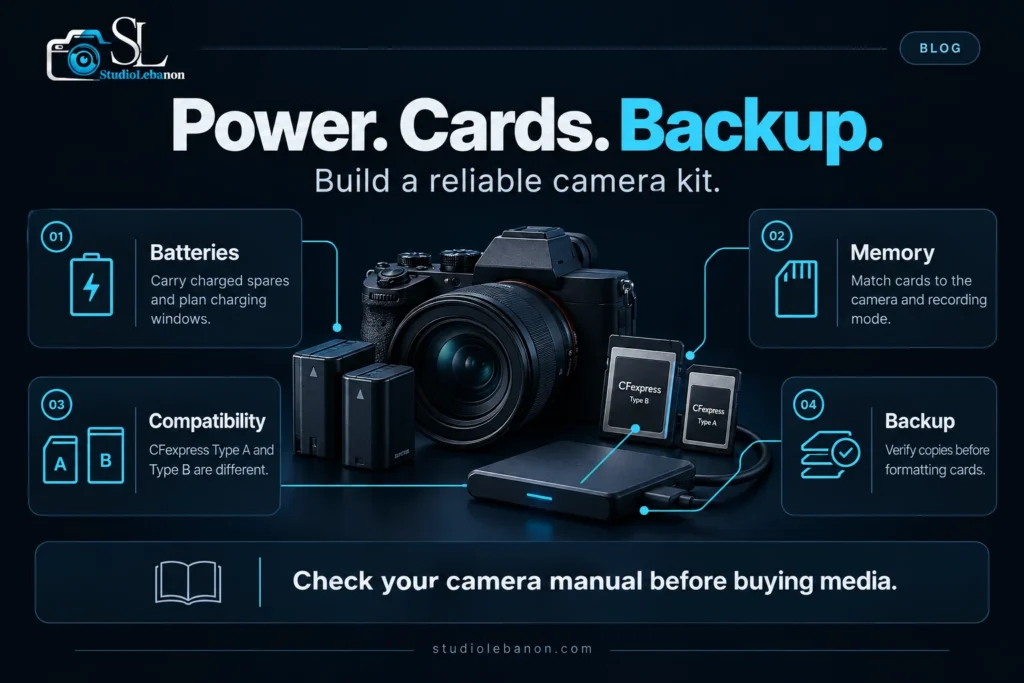
In Lebanon, shoots rarely fail because of the camera. They fail because a battery died during a power cut or a card couldn’t keep up with the bitrate. Carry at least three charged batteries per shooting day, and match your card to your codec: V30 for up to 200 Mbps, V60 for around 280 Mbps, V90 or CFexpress Type A for Sony’s 600 Mbps All-Intra, and CFexpress Type B for RAW on the Canon R5 II and R6 III.
This is a practical guide to camera accessories in Lebanon: power, media and backups. We’ll be upfront about our shop. Our Power, Memory & Accessories category lists one product today, the Sony NP-F550 battery at $25. Like everything on studiolebanon.com/shop, it’s priced to be the best price in Lebanon on original gear, with 2–3 business day delivery across Lebanon. The category is growing. If you need something that isn’t listed, ask us through the contact page or the Contact Us button on any product page, and we’ll tell you honestly whether we can source it.
Finding 1: Power cuts turn batteries into a planning problem, not a spec
Claim: In much of Lebanon, the state grid is still rationed and homes and studios switch between the grid, a generator subscription and solar. Your charging plan has to work around that.
Data: The practical effects we plan around: charging windows are unpredictable, and generator switchovers can cause surges and short dropouts that interrupt a charge. Modern bodies help. The Sony A7 V’s NP-FZ100 (7.2V, 2,280 mAh) supports USB Power Delivery charging, so a USB-C PD power bank can top the camera up in a car or on location. Canon’s LP-E6P, used by the R5 II and R6 III, is rated at roughly 270–340 shots per charge through the viewfinder under CIPA testing, which makes it clear why one battery isn’t a shoot day.
Practical translation: Charge everything the night before whenever the power is stable, plug chargers into a surge-protected strip, and keep a USB-C PD power bank in the bag as a backup.
Finding 2: Know your camera’s battery and card type before you buy anything
Claim: The eight cameras we sell use four battery types and three kinds of card slot. Buying the wrong one is an easy, expensive mistake, and one table prevents it.
Data: Here’s what each camera in our lineup uses, from the manufacturers’ specs:
| Camera (our price) | Battery | Card slots | Card for demanding video |
|---|---|---|---|
| Canon EOS R50 + 18-45mm ($670) | LP-E17 | 1× SD (UHS-I) | V30 (max bitrate is around 120 Mbps) |
| Canon EOS R8 + 24-50mm ($1,240) | LP-E17 | 1× SD (UHS-II) | V60/V90 UHS-II for 4K 60p and high frame rates |
| Canon R6 II + 24-105 STM ($2,380) | LP-E6NH | 2× SD (UHS-II) | V60/V90 UHS-II for 4K 60p and high frame rates |
| Canon EOS R6 Mark III ($2,480) | LP-E6P | 1× CFexpress Type B + 1× SD (UHS-II) | CFexpress Type B for 7K RAW |
| Canon EOS R5 II body ($3,450) | LP-E6P | 1× CFexpress Type B + 1× SD (UHS-II) | CFexpress Type B (VPG400) for 8K RAW |
| Sony A7 IV body ($1,850) | NP-FZ100 | Slot 1 CFexpress Type A/SD, slot 2 SD | V90 or CFexpress Type A for 600 Mbps XAVC S-I |
| Sony A7 V ($2,480) | NP-FZ100 | Slot 1 CFexpress Type A/SD, slot 2 SD | V90 or CFexpress Type A for 600 Mbps XAVC S-I |
| Sony FX3A ($3,300) | NP-FZ100 | 2× CFexpress Type A/SD | V90 or CFexpress Type A (VPG200) for 600 Mbps XAVC S-I |
Practical translation: Find your camera in the table before you buy a single card or spare battery. All eight bodies are in our Cameras & Lenses category.
Finding 3: Pick a card by bitrate, and the math takes 10 seconds
Claim: Video speed classes are a guaranteed minimum sustained write speed in megabytes per second. Divide your camera’s bitrate in megabits by 8 and you know which class you need.
Data: V30 guarantees 30 MB/s, V60 guarantees 60 MB/s and V90 guarantees 90 MB/s. Sony’s own help guides set the thresholds: the A7 IV needs V30 for 200 Mbps 4K, the FX3 line needs V60 for 280 Mbps 4K, and both need V90 or CFexpress Type A (VPG200) for 600 Mbps XAVC S-I. Here’s our own calculation of what that means on a card:
| Bitrate | Data per second | Minimum card | Approx. recording time |
|---|---|---|---|
| 100 Mbps (HD) | 12.5 MB/s | U3 / V30 | About 170 min on 128 GB |
| 200 Mbps (Sony 4K XAVC HS/S) | 25 MB/s | V30 | About 85 min on 128 GB |
| 280 Mbps (FX3A 4K XAVC S/HS) | 35 MB/s | V60 | About 60 min on 128 GB |
| 600 Mbps (Sony XAVC S-I 4K) | 75 MB/s | V90 or CFexpress Type A | About 28 min on 128 GB |
| Up to 2,600 Mbps (Canon RAW Standard) | Up to 325 MB/s | CFexpress Type B, VPG400 | About 26 min on 512 GB |
Practical translation: A 128 GB V90 card holds under half an hour of Sony All-Intra. Plan card counts from your bitrate, not from the card’s headline size.
Finding 4: CFexpress Type A and Type B are not interchangeable
Claim: The two CFexpress types look similar in a product listing but are physically different cards.
Data: Sony’s FX3A, A7 IV and A7 V take CFexpress Type A, and Sony’s FX3 help guide states plainly that Type B cards can’t be used. Canon’s R5 II and R6 III take CFexpress Type B, which is what their RAW modes need. There’s one more trap: on dual-slot cameras, recording to both slots at once for backup runs at the speed of the slower card. Put a V60 SD next to a fast CFexpress and your backup recording is limited to what the V60 can handle.
Practical translation: Match the CFexpress type to your camera brand, and use two cards of equal speed if you record to both slots.
Finding 5: The NP-F550 isn’t a camera battery. It powers everything around the camera
Claim: Sony’s L-series NP-F batteries are the standard power source for on-camera LED panels, field monitors and many older Sony camcorders, not for the mirrorless bodies above.
Data: NP-F550-type packs are 7.2V L-series batteries, and capacities across brands range from roughly 2,000 to 3,500 mAh. Ours is the Sony NP-F550 at $25, priced to be the best in Lebanon. Because the mount is shared across the whole L-series, a light or monitor that takes an NP-F550 can usually take larger NP-F750 and NP-F970 packs too, as long as there’s physical clearance, which is the easy upgrade when you need longer runtime. They’re also small enough to fly with: spare lithium batteries go in your carry-on, and packs under 100 Wh don’t need airline approval.
Practical translation: If your LED panel or monitor has a Sony L-series plate, keep at least two NP-F550s in rotation so one charges while the other runs.
Finding 6: Backups matter more than card speed
Claim: A card that fails after the shoot costs you more than a slow card ever will.
Data: Counterfeit and relabeled memory cards are a known global problem, and they often pass a quick test while failing on long recordings. Verify any new card’s real capacity and speed with a free tool such as H2testw (Windows) or F3 (Mac and Linux) before a paid job. Then follow the 3-2-1 rule: 3 copies of the footage, on 2 different kinds of media, with 1 copy kept somewhere else. With power as unreliable as it is, copy footage to a laptop or SSD the same day rather than leaving it on the card.
Practical translation: Never format a card until the footage exists in two other places.
Finding 7: Buying accessories in Lebanon: ask about the warranty and keep the invoice
Claim: Small accessories are where grey imports and fakes hide most easily, so who you buy from matters.
Data: Accessories in Lebanon are sold in USD, and a lot of stock is grey import, meaning it was bought outside the brand’s regional channel. That changes who handles a faulty unit. Whoever you buy from, know who covers a defective battery or card, and get a dated invoice. On studiolebanon.com/shop, you get original gear at what we’ve priced to be the best prices in Lebanon and ships across Lebanon in 2–3 business days. We explain how delivery works in our shop launch post.
Practical translation: Test every battery and card in its first week of use.
Which accessories should you buy? Our answer by camera and use case
Canon R50 or R8 creators
Buy two spare LP-E17 batteries. These are small packs, so you’ll go through them fast in 4K. For the R50, two 128 GB V30 cards are enough because its UHS-I slot gets no benefit from faster cards. For the R8, step up to UHS-II V60 if you shoot 4K 60p or high frame rates.
Sony A7 IV or A7 V hybrid shooters
Carry three NP-FZ100s and a USB-C PD power bank. Put a CFexpress Type A or V90 card in slot 1 if you shoot 600 Mbps All-Intra, and a matching V90 in slot 2 if you record backups.
Sony FX3A for cinema-style work
Use two identical CFexpress Type A cards (VPG200) so backup recording runs at full speed, plus three or more NP-FZ100s for long interview days.
Canon R5 II or R6 III shooting RAW
Buy CFexpress Type B, VPG400, in 512 GB or larger, since RAW fills about 512 GB in under half an hour. Keep the SD slot for proxies or photos, and carry at least three LP-E6P batteries.
Anyone running LED panels or a field monitor
Start with two Sony NP-F550 batteries ($25 each) and a dual charger. Move up to NP-F750 or NP-F970 packs if you need hours of runtime.
Studio renters
If you’re booking our studio, bring charged camera batteries and cleared cards. The studio has universal plugs for charging, but a shoot hour spent waiting on a battery is still an hour you’re paying for. The same applies to talking head and podcast sessions, which record for long stretches.
What didn’t actually matter: two myths
Myth 1: “A faster card gives better image quality.” It doesn’t. The card only has to keep up with the bitrate. A V90 card in a Canon R50 records the same footage as a V30, because the slot is UHS-I and the bitrate is around 120 Mbps.
Myth 2: “One big card is safer than two small ones.” It’s the opposite. One 512 GB card is one point of failure. Two 256 GB cards, swapped mid-day and backed up, protect half the day if something goes wrong.
What to do this week
- Find your camera in the table above and write down its battery model, card type and the bitrate you actually shoot.
- Count your batteries. If you have fewer than three for your main camera, that’s your first purchase.
- Test every card you own with H2testw or F3, and retire any card that reports errors or less capacity than it claims.
- Set up a same-day backup routine: card to laptop or SSD, then to a second drive or the cloud.
- Browse our Power, Memory & Accessories category and message us about any battery, card or charger you need that isn’t listed yet.
FAQ
Where can I buy camera accessories Lebanon-wide, with delivery? Our Power, Memory & Accessories category currently lists the Sony NP-F550 battery at $25, priced to be the best in Lebanon and delivered across Lebanon in 2–3 business days. The category is expanding, and you can ask us to source other batteries, cards or chargers through the contact page.
Which memory card do I need for 4K video? It depends on the bitrate, not the resolution. V30 covers 4K at up to 200 Mbps, V60 covers about 280 Mbps, and Sony’s 600 Mbps All-Intra needs V90 or CFexpress Type A. Canon RAW on the R5 II and R6 III needs CFexpress Type B.
Does the Sony NP-F550 work in the Sony A7 IV, A7 V or FX3A? No. Those cameras use the NP-FZ100. The NP-F550 powers accessories with a Sony L-series plate, such as LED panels, field monitors and many older Sony camcorders.
How many batteries do I need for a full shoot day? Plan for at least three per camera, and more if you record long interviews or shoot in heat. With power cuts common, a USB-C PD power bank is the cheapest insurance for cameras that support in-camera charging.
Can I use a CFexpress Type B card in a Sony camera? No. Sony’s FX3A, A7 IV and A7 V take CFexpress Type A. Type B cards fit Canon’s R5 II and R6 III.
Need a battery, card or accessory we don’t list yet?
Tell us your camera and what you shoot, and we’ll tell you exactly which batteries and cards you need and whether we can get them for you, at our shop’s best-in-Lebanon pricing. Contact StudioLebanon or call +961 76 393 638.